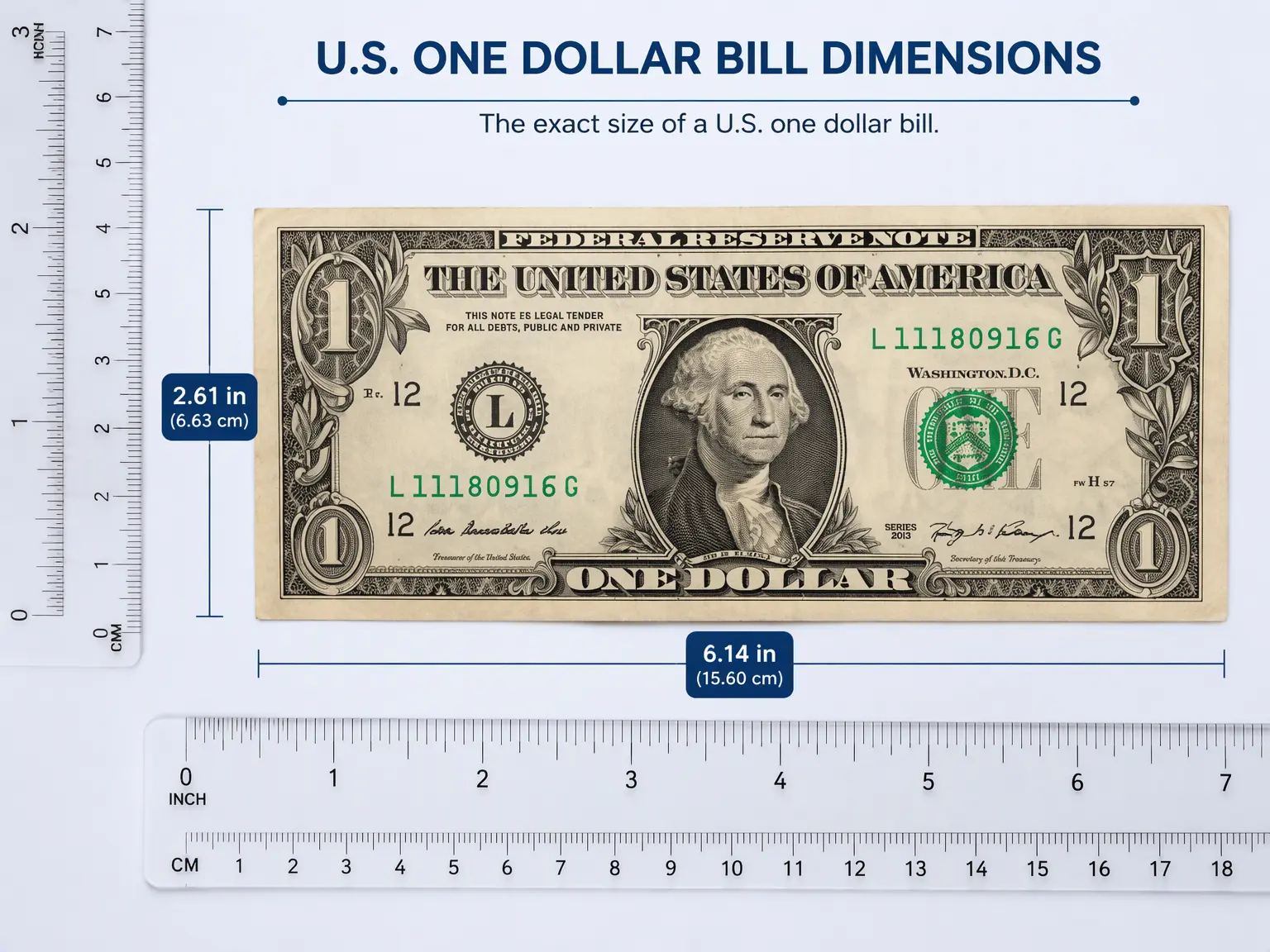
If you have ever wondered about the size of a dollar bill in inches, the standard U.S. dollar bill measures 6.14 inches long and 2.61 inches wide. This measurement applies to every commonly circulating U.S. banknote, including the $1, $2, $5, $10, $20, $50, and $100 bills.
Although these bills have different values, colors, portraits, and security features, they all share the same physical dimensions. This makes American currency easy to store, count, handle, and process through banking machines.
Knowing the exact dimensions can also help when measuring money for school projects, designing wallets, creating display frames, or comparing U.S. currency with money from other countries. In this guide, you will learn the exact measurements, metric conversions, historical size changes, and useful comparisons.
How Big Is a Dollar Bill in Inches?
A standard U.S. dollar bill is 6.14 inches long and 2.61 inches wide. It has a rectangular shape, and its dimensions remain consistent across all standard denominations.
Here is a quick breakdown:
-
Length: 6.14 inches
-
Width: 2.61 inches
-
Thickness: Approximately 0.0043 inches
-
Shape: Rectangle
-
Weight: Approximately 1 gram
The measurements are useful for understanding how much space a banknote takes up in a wallet, cash drawer, money clip, or storage container.
The U.S. Currency Education Program confirms that modern American banknotes were standardized at approximately 6.14 × 2.61 inches in 1929.
U.S. Currency Education Program+1
Dollar Bill Dimensions in Inches and Other Measurements
The dimensions of U.S. paper money can also be expressed in fractions, millimeters, and centimeters. These conversions make it easier to understand the actual size of American currency.
| Measurement | Inches | Metric |
|---|---|---|
| Length | 6.14 inches | 155.96 mm |
| Width | 2.61 inches | 66.29 mm |
| Thickness | Approx. 0.0043 inches | Approx. 0.109 mm |
The length and width are the standard dimensions of modern U.S. banknotes. The thickness is an approximate commonly cited measurement rather than a separately listed standard dimension in the official currency specifications.
Dollar Bill Size in Centimeters
If you prefer metric measurements, a U.S. dollar bill is approximately:
-
15.6 centimeters long.
-
6.63 centimeters wide.
-
0.011 centimeters thick.
These measurements are useful when working with international measurement systems or comparing American money with foreign banknotes.
Dollar Bill Size as a Fraction
The length of a dollar bill is also commonly described as approximately 6 1/8 inches.
Its width is approximately 2 5/8 inches.
These fractional measurements are rounded values. For accurate measuring, use the decimal dimensions of 6.14 inches by 2.61 inches.
Are All U.S. Dollar Bills the Same Size?
Yes. All seven standard U.S. currency denominations have the same physical dimensions. A $1 bill is the same size as a $100 bill.
The following table shows the standard size of each denomination.
| U.S. Bill | Length | Width |
|---|---|---|
| $1 bill | 6.14 inches | 2.61 inches |
| $2 bill | 6.14 inches | 2.61 inches |
| $5 bill | 6.14 inches | 2.61 inches |
| $10 bill | 6.14 inches | 2.61 inches |
| $20 bill | 6.14 inches | 2.61 inches |
| $50 bill | 6.14 inches | 2.61 inches |
| $100 bill | 6.14 inches | 2.61 inches |
Although the denominations have different designs and security features, their overall dimensions remain identical. The Bureau of Engraving and Printing confirms that it produces all seven of these denominations.
Engraving & Printing+1
Why Do All Dollar Bills Have the Same Dimensions?
The United States uses standardized banknote dimensions to make currency production and handling more efficient.
This uniformity offers several advantages:
-
Easy storage: Different denominations fit into the same wallets and cash drawers.
-
Machine compatibility: Currency-counting and processing equipment can handle different denominations using consistent dimensions.
-
Simpler production: Standardized sizes help streamline printing and manufacturing.
-
Convenient handling: People can organize and count different bills without dealing with different physical sizes.
Unlike some countries, the United States does not use different banknote sizes to distinguish denominations.
How Thick Is a Dollar Bill?
A single U.S. dollar bill is approximately 0.0043 inches thick, or about 0.109 millimeters.
That makes it extremely thin compared with most everyday objects. However, U.S. currency is designed to withstand regular handling, folding, and circulation.
The thickness of a banknote can vary slightly depending on its condition, wear, and handling. Therefore, the measurement should be treated as an approximate figure.
How High Is a Stack of Dollar Bills?
You can estimate the height of a stack by multiplying the approximate thickness of one bill by the number of bills.
| Number of Bills | Approximate Stack Height |
|---|---|
| 10 bills | 0.043 inches |
| 50 bills | 0.215 inches |
| 100 bills | 0.43 inches |
| 500 bills | 2.15 inches |
| 1,000 bills | 4.3 inches |
For example, a stack of 100 bills would measure approximately 0.43 inches high.
These calculations are useful for understanding cash storage, counting money, and estimating the space needed for large amounts of currency.
Why Did the United States Standardize Dollar Bill Dimensions?
Modern U.S. currency became smaller and more uniform following a major change in 1929.
Before this change, American banknotes were larger. Many older notes measured approximately 7.375 inches long and 3.125 inches wide.
The government introduced smaller banknotes to reduce production costs and simplify currency handling.
The modern dimensions became approximately 6.14 inches by 2.61 inches. This represented a reduction of about 30% in overall size compared with the earlier format.
U.S. Currency Education Program+1
Old Dollar Bill Size vs. Modern Dollar Bill Size
| Feature | Older Large-Size Notes | Modern Standard Notes |
|---|---|---|
| Length | 7.375 inches | 6.14 inches |
| Width | 3.125 inches | 2.61 inches |
| Shape | Rectangle | Rectangle |
| Size category | Large-size currency | Small-size currency |
The smaller format made banknotes easier to carry, store, and process. It also helped establish the consistent dimensions used for modern American currency.
What Is the Size of a Dollar Bill Compared with Everyday Objects?
Sometimes measurements are easier to understand when compared with familiar objects.
A U.S. dollar bill is approximately 6.14 inches long and 2.61 inches wide. Its rectangular shape makes it easy to compare with several common items.
Dollar Bill vs. Credit Card
A standard credit card measures approximately 3.37 inches long and 2.125 inches wide.
Compared with a credit card, a dollar bill is:
-
About 2.77 inches longer.
-
About 0.49 inches wider.
This means a dollar bill takes up more surface area than a standard credit card.
Dollar Bill vs. Smartphone
Most modern smartphones are longer than a dollar bill, although their dimensions vary by model.
A typical smartphone can measure between 5.5 and 7 inches in height. This makes a dollar bill a useful reference when visualizing the length of smaller mobile devices.
Dollar Bill vs. Index Card
A common 3 × 5-inch index card is shorter and slightly wider than a dollar bill.
A dollar bill measures 6.14 × 2.61 inches, so it has a longer, narrower shape.
These comparisons help students and anyone working with measurements visualize the size of American paper currency.
What Are U.S. Dollar Bills Made Of?
Although people commonly call them paper money, U.S. banknotes are not made from ordinary wood-pulp paper.
According to the Federal Reserve, currency paper consists of:
-
75% cotton.
-
25% linen.
It also contains small red and blue security fibers distributed throughout the material.
Federal Reserve Financial Services+1
This special material gives banknotes a distinctive feel and helps them withstand everyday use.
Why Is Dollar Bill Material Important?
The cotton-and-linen composition helps make currency stronger than ordinary writing paper.
It is designed to handle repeated use, folding, and circulation. This is important because banknotes pass through many hands during their lifetime.
The material also provides a suitable surface for detailed printing, portraits, serial numbers, and security features.
Does the $100 Bill Have Different Dimensions from the $1 Bill?
No. A $100 bill has exactly the same standard length and width as a $1 bill.
Both measure approximately 6.14 inches long and 2.61 inches wide.
The main differences are their printed designs, portraits, colors, and security features.
For example, the $1 bill features George Washington, while the $100 bill features Benjamin Franklin.
Even though their monetary values are very different, their physical dimensions are the same.
How Can You Measure a Dollar Bill Correctly?
If you want to check the size of a dollar bill yourself, you only need a ruler or measuring tape.
Follow these simple steps:
-
Place the dollar bill on a flat surface.
-
Straighten it carefully without stretching or damaging it.
-
Position your ruler along its longest edge.
-
Measure from one end to the other.
-
Turn the ruler to measure the shorter edge.
You should get approximately 6.14 inches in length and 2.61 inches in width.
For the most accurate result, use a ruler with decimal-inch markings or a digital measuring tool.
Why Are Dollar Bill Dimensions Important?
The standard size of American currency serves several practical purposes.
For everyday users: Standard dimensions allow bills to fit conveniently inside wallets, purses, and money clips.
For businesses: Cash registers, currency counters, and other money-handling equipment benefit from consistent banknote sizes.
For designers: People creating wallets, money holders, display frames, and storage products need accurate measurements.
For students: Dollar bill dimensions provide a simple real-world example of length, width, area, and unit conversion.
For collectors: Understanding standard and historical banknote dimensions helps when organizing, displaying, and preserving currency.
Knowing these measurements is useful beyond simply identifying the size of a dollar bill.
Frequently Asked Questions About Dollar Bill Size
1. What is the exact size of a dollar bill in inches?
A standard U.S. dollar bill measures 6.14 inches long and 2.61 inches wide. These dimensions apply to all seven standard denominations.
2. How many inches long is a $1 bill?
A $1 bill is approximately 6.14 inches long. Its width is approximately 2.61 inches.
3. Are all American dollar bills the same size?
Yes. The $1, $2, $5, $10, $20, $50, and $100 bills all share the same standard dimensions.
4. How wide is a dollar bill in inches?
A standard U.S. dollar bill is 2.61 inches wide. This measurement is the same across all standard denominations.
5. How long is a dollar bill in centimeters?
A dollar bill is approximately 15.6 centimeters long and 6.63 centimeters wide.
6. How thick is a U.S. dollar bill?
A U.S. dollar bill is approximately 0.0043 inches thick. This is a commonly cited estimate rather than an exact guaranteed measurement for every note.
7. When did dollar bills become smaller?
The United States standardized its smaller banknote format in 1929. Earlier large-size notes measured approximately 7.375 × 3.125 inches.
8. Is a $100 bill bigger than a $1 bill?
No. Both bills have identical physical dimensions. The only differences are their monetary values, designs, portraits, and security features.
9. What is the size of a dollar bill in millimeters?
A standard dollar bill measures approximately 156 millimeters long and 66.3 millimeters wide.
10. What material is used to make U.S. dollar bills?
U.S. currency paper consists of 75% cotton and 25% linen. It also contains red and blue security fibers.
Conclusion
The standard size of a dollar bill in inches is 6.14 inches long and 2.61 inches wide. These measurements apply to every standard U.S. currency denomination, from the $1 bill to the $100 bill.
A dollar bill is also approximately 0.0043 inches thick and weighs around one gram. In metric measurements, it is about 15.6 centimeters long and 6.63 centimeters wide.
The United States standardized its smaller banknote dimensions in 1929 to make currency production and handling more efficient. Today, the consistent size makes American money easier to carry, store, count, and process.
Whether you are measuring a banknote for a school project, designing a wallet, comparing currencies, or simply satisfying your curiosity, these measurements give you a clear understanding of the size of U.S. paper money.