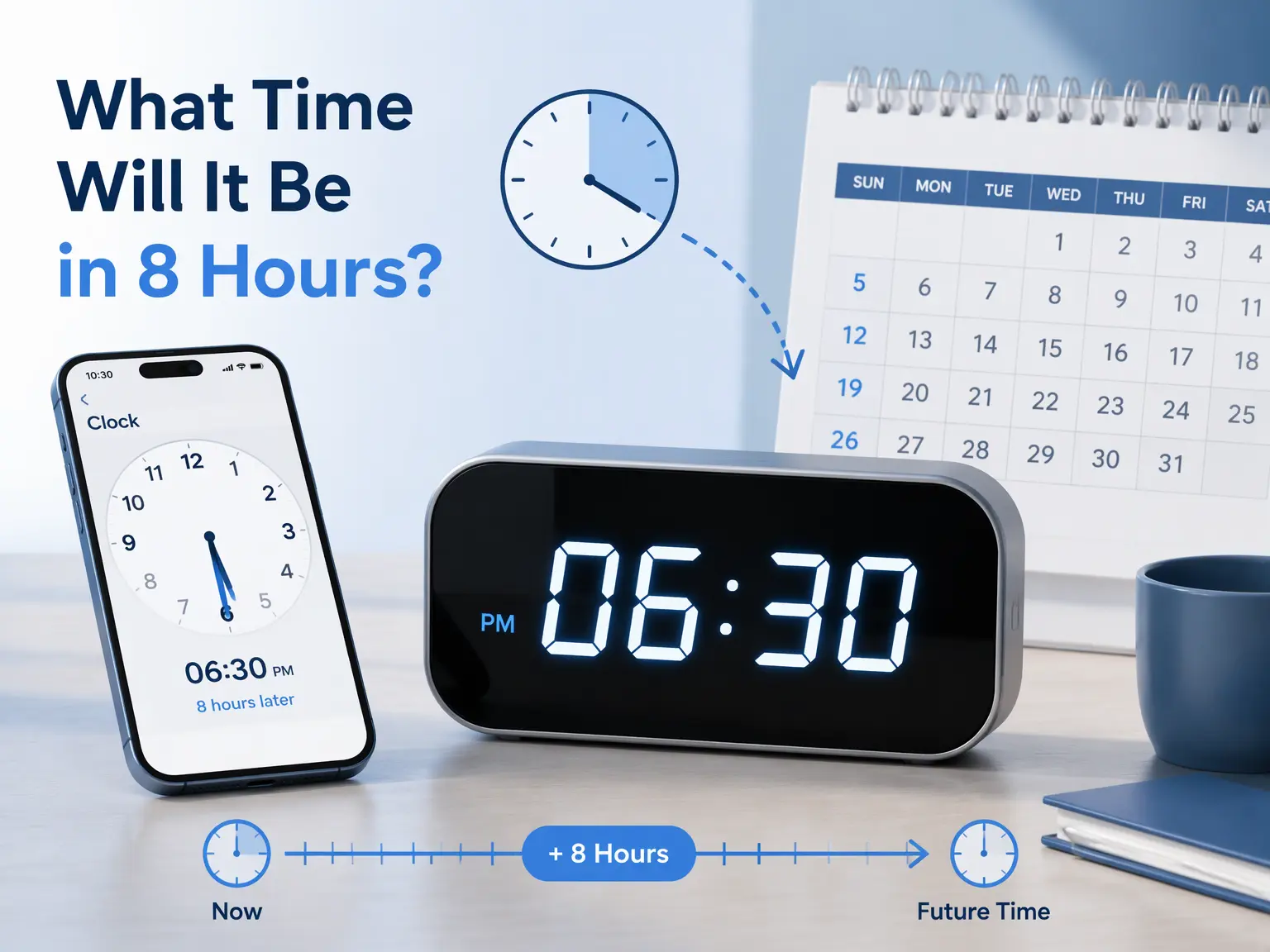
If you need to know what time will it be in 8 hours, you can find the answer by adding eight hours to your current local time. This calculation is useful when planning work schedules, setting reminders, arranging appointments, or figuring out when an activity will finish. The result depends on your starting time and time zone. Sometimes, eight hours later will be on the same day. In other cases, the calculation will cross midnight and move into the next calendar day. Understanding this simple time calculation can help you plan your day without confusion. You can also calculate it manually without using a special tool.
What Time Will It Be in 8 Hours From Now?
To find out what time it will be in 8 hours, simply add eight hours to the current clock time. Keep the minutes unchanged because you are adding full hours.
For example:
- 7:00 AM + 8 hours = 3:00 PM
- 9:00 AM + 8 hours = 5:00 PM
- 10:30 AM + 8 hours = 6:30 PM
- 12:00 PM + 8 hours = 8:00 PM
- 3:00 PM + 8 hours = 11:00 PM
- 5:00 PM + 8 hours = 1:00 AM the next day
- 10:00 PM + 8 hours = 6:00 AM the next day
The exact answer depends on the time when you start counting. If you want an accurate result, use your current local time rather than a time from another location.
How to Calculate 8 Hours From Now
Calculating eight hours from now is simple. You do not need advanced math or a complicated time calculator. Follow these steps to find the correct result.
Step 1: Check Your Current Time
Start by looking at your phone, computer, watch, or another reliable clock.
For example, suppose the current time is 8:25 AM.
Write down the starting time so you do not accidentally change the minutes during the calculation.
Step 2: Add Eight Hours
Now add eight to the hour.
In this example:
8 + 8 = 16
The number 16 represents 4:00 PM in the 12-hour clock format.
Step 3: Keep the Minutes Unchanged
Because you are adding exactly eight hours, the minutes remain the same.
Therefore:
8:25 AM + 8 hours = 4:25 PM.
Step 4: Check Whether the Date Changes
If your calculation goes past midnight, the answer belongs to the following day.
For example:
8:25 PM + 8 hours = 4:25 AM the next day.
Always check the date when calculating a future time late in the evening.
What Is 8 Hours From Now in the AM and PM Format?
The United States commonly uses the 12-hour clock format. This system divides the day into two periods: AM and PM.
AM covers the hours from midnight until before noon. PM covers noon until before midnight.
When adding eight hours, you may need to change the AM or PM label.
Here are some examples:
| Starting Time | Duration | Future Time |
|---|---|---|
| 6:00 AM | 8 hours | 2:00 PM |
| 7:30 AM | 8 hours | 3:30 PM |
| 9:15 AM | 8 hours | 5:15 PM |
| 11:00 AM | 8 hours | 7:00 PM |
| 12:30 PM | 8 hours | 8:30 PM |
| 2:45 PM | 8 hours | 10:45 PM |
| 4:00 PM | 8 hours | 12:00 AM next day |
| 8:30 PM | 8 hours | 4:30 AM next day |
| 11:15 PM | 8 hours | 7:15 AM next day |
These examples show that the minutes do not change when you add a whole number of hours.
What Is 8 Hours From Now in the 24-Hour Clock?
The 24-hour clock is another way to calculate future time. It is commonly used in transportation, healthcare, military schedules, and international settings.
Instead of using AM and PM, this format counts the hours from 00:00 through 23:59.
To calculate eight hours later, add eight to the starting hour.
For example:
- 06:00 + 8 hours = 14:00
- 08:30 + 8 hours = 16:30
- 10:15 + 8 hours = 18:15
- 13:00 + 8 hours = 21:00
- 16:45 + 8 hours = 00:45 the next day
- 21:30 + 8 hours = 05:30 the next day
If the result reaches 24:00 or goes beyond it, subtract 24 hours and move to the following date.
For example, 21:30 plus eight hours equals 29:30. Subtracting 24 hours gives 05:30 the next day.
This format can make time calculations easier because you do not have to switch between AM and PM.
How Many Minutes and Seconds Are in 8 Hours?
Eight hours is a fixed period of time. You can convert it into smaller units by multiplying the number of hours.
Here is a quick breakdown:
| Time Unit | Equivalent |
|---|---|
| Hours | 8 |
| Minutes | 480 |
| Seconds | 28,800 |
| Milliseconds | 28,800,000 |
| Days | One-third of a day |
The calculations are straightforward:
- 8 × 60 = 480 minutes.
- 480 × 60 = 28,800 seconds.
- 28,800 × 1,000 = 28,800,000 milliseconds.
These conversions are useful when working with schedules, timers, digital systems, and countdowns.
Does 8 Hours From Now Mean the Same Time Tomorrow?
No. Eight hours from now does not automatically mean the same clock time tomorrow.
A complete day contains 24 hours, while eight hours represents only one-third of a day.
The result may fall later on the same day or early the following morning.
For example:
- Starting at 8:00 AM gives 4:00 PM on the same day.
- Starting at 2:00 PM gives 10:00 PM on the same day.
- Starting at 7:00 PM gives 3:00 AM the next day.
- Starting at 11:00 PM gives 7:00 AM the next day.
You should always check whether your calculation crosses midnight before deciding which date to use.
Why Your Time Zone Matters When Calculating 8 Hours From Now
Your time zone determines how a future time appears on your local clock.
The duration of eight hours stays the same, but the displayed clock time can differ between locations.
For example, someone in New York and someone in Los Angeles may see different local clock readings for the same future moment.
The United States has several time zones, including:
- Eastern Time (ET)
- Central Time (CT)
- Mountain Time (MT)
- Pacific Time (PT)
- Alaska Time (AKT)
- Hawaii-Aleutian Time (HAT)
When arranging an online meeting or planning an international call, make sure everyone is using the correct time zone.
It is also important to remember that daylight saving time can change local clock readings. In areas that observe it, clocks usually move forward in spring and backward in fall.
For most everyday calculations, adding eight elapsed hours to the current moment gives the correct future instant. However, if a calculation crosses a daylight saving time transition, the local clock may not show a simple eight-hour difference.
What Time Will It Be in 8 Hours for Different Daily Activities?
People often calculate eight hours ahead because they need to plan something. Understanding how this period fits into everyday activities can make scheduling easier.
Eight-Hour Work Shift
An eight-hour work shift is a common scheduling arrangement.
For example, if you start working at 9:00 AM, adding eight hours gives 5:00 PM.
However, remember that unpaid lunch breaks may extend the time you need to remain at work.
Eight-Hour Sleep Schedule
Some people use an eight-hour period when planning their sleep schedule.
For example, going to bed at 10:30 PM and adding eight hours gives 6:30 AM.
This is simply a time-planning example. Individual sleep needs can vary.
Eight-Hour Travel Period
An eight-hour journey can make it useful to calculate the expected arrival time before leaving.
If a trip starts at 11:00 AM and takes eight hours, the estimated arrival time is 7:00 PM.
For flights and international travel, remember to account for the destination’s time zone and any schedule changes.
Eight-Hour Medication or Reminder Schedule
Some personal schedules use repeated intervals, including eight-hour reminders.
If a reminder starts at 7:00 AM, another reminder eight hours later would be at 3:00 PM.
For medication, always follow the specific instructions provided by your healthcare professional or medication label rather than changing a prescribed schedule based only on a time calculation.
Common Mistakes When Adding 8 Hours
Even though this calculation is easy, small mistakes can lead to incorrect results.
Here are some common problems to avoid.
Forgetting to Change AM to PM
If you start at 9:00 AM, adding eight hours gives 5:00 PM, not 5:00 AM.
Always check whether the calculation passes noon.
Forgetting About Midnight
If you start at 6:00 PM, eight hours later is 2:00 AM the following day.
The calendar date changes when the calculation passes midnight.
Changing the Minutes
When adding exactly eight hours, the minutes remain unchanged.
For example, 10:35 AM becomes 6:35 PM.
It does not become 6:43 PM or another minute value.
Using the Wrong Time Zone
A time calculation based on New York time will not necessarily match the local clock in California.
Check the location before confirming appointments or online meetings.
Ignoring Daylight Saving Time
Some US locations change their clocks during the year. If your eight-hour period crosses a daylight saving transition, the displayed local time may differ from an ordinary calculation.
Tips for Getting an Accurate Future Time
Use these simple tips whenever you need to calculate eight hours from the current time:
- Check your current local time before starting.
- Add eight to the hour rather than the minutes.
- Keep the minutes unchanged.
- Check whether the result passes noon or midnight.
- Include the following date if the calculation crosses midnight.
- Confirm the time zone when coordinating with someone in another location.
- Use a digital time calculator when you need to check a complicated schedule.
For an ordinary calculation, mental addition is usually enough. A calculator is helpful when dates, time zones, or daylight saving changes are involved.
What Is the Difference Between 8 Hours From Now and 8 Hours Ago?
These two expressions describe opposite directions in time.
Eight hours from now means moving forward from the current moment. Eight hours ago means moving backward.
For example, if the current time is 2:00 PM:
- Eight hours from now is 10:00 PM.
- Eight hours ago was 6:00 AM.
The same principle works with any starting time. You add eight hours to calculate the future and subtract eight hours to calculate the past.
This distinction is useful when checking previous events, planning future appointments, or calculating how long something has taken.
Conclusion
Finding out what time will it be in 8 hours is easy once you understand the basic rule: add eight hours to your current local time. Keep the minutes unchanged and check whether the result moves into the next calendar day. For example, 9:00 AM becomes 5:00 PM, while 9:00 PM becomes 5:00 AM the following day. Your time zone and daylight saving changes can also affect the displayed clock time. Whether you are planning a work shift, arranging a meeting, preparing for travel, or setting a reminder, this simple calculation can help you manage your schedule more accurately.
Frequently Asked Questions
1. What time will it be in 8 hours?
Add eight hours to your current local time. For example, if it is 10:00 AM now, it will be 6:00 PM in eight hours.
2. How do I calculate 8 hours from now?
Check your current time and add eight to the hour. Keep the minutes unchanged and adjust the date if the calculation passes midnight.
3. What time is 8 hours after 7 AM?
Eight hours after 7:00 AM is 3:00 PM on the same day.
4. What time is 8 hours after 10 AM?
Eight hours after 10:00 AM is 6:00 PM.
5. What time is 8 hours after 12 PM?
Eight hours after 12:00 PM (noon) is 8:00 PM.
6. What time is 8 hours after 5 PM?
Eight hours after 5:00 PM is 1:00 AM the following day.
7. How many minutes are in 8 hours?
There are 480 minutes in eight hours because one hour contains 60 minutes.
8. How many seconds are in 8 hours?
Eight hours contain 28,800 seconds. You get this number by multiplying 480 minutes by 60 seconds.
9. Does adding 8 hours change the minutes?
No. When you add exactly eight hours, the minutes and seconds remain unchanged. For example, 11:20 AM becomes 7:20 PM.
10. Can I calculate 8 hours from now without a calculator?
Yes. Simply add eight hours to your current clock time. Check the AM/PM period and move to the next date if the calculation passes midnight.
11. Does daylight saving time affect an 8-hour calculation?
It can affect the displayed local clock time if the period crosses a daylight saving transition. The elapsed duration remains eight hours, but the local clock may move forward or backward.
12. Is 8 hours one-third of a day?
Yes. A full day contains 24 hours, and eight hours is exactly one-third of that period.