
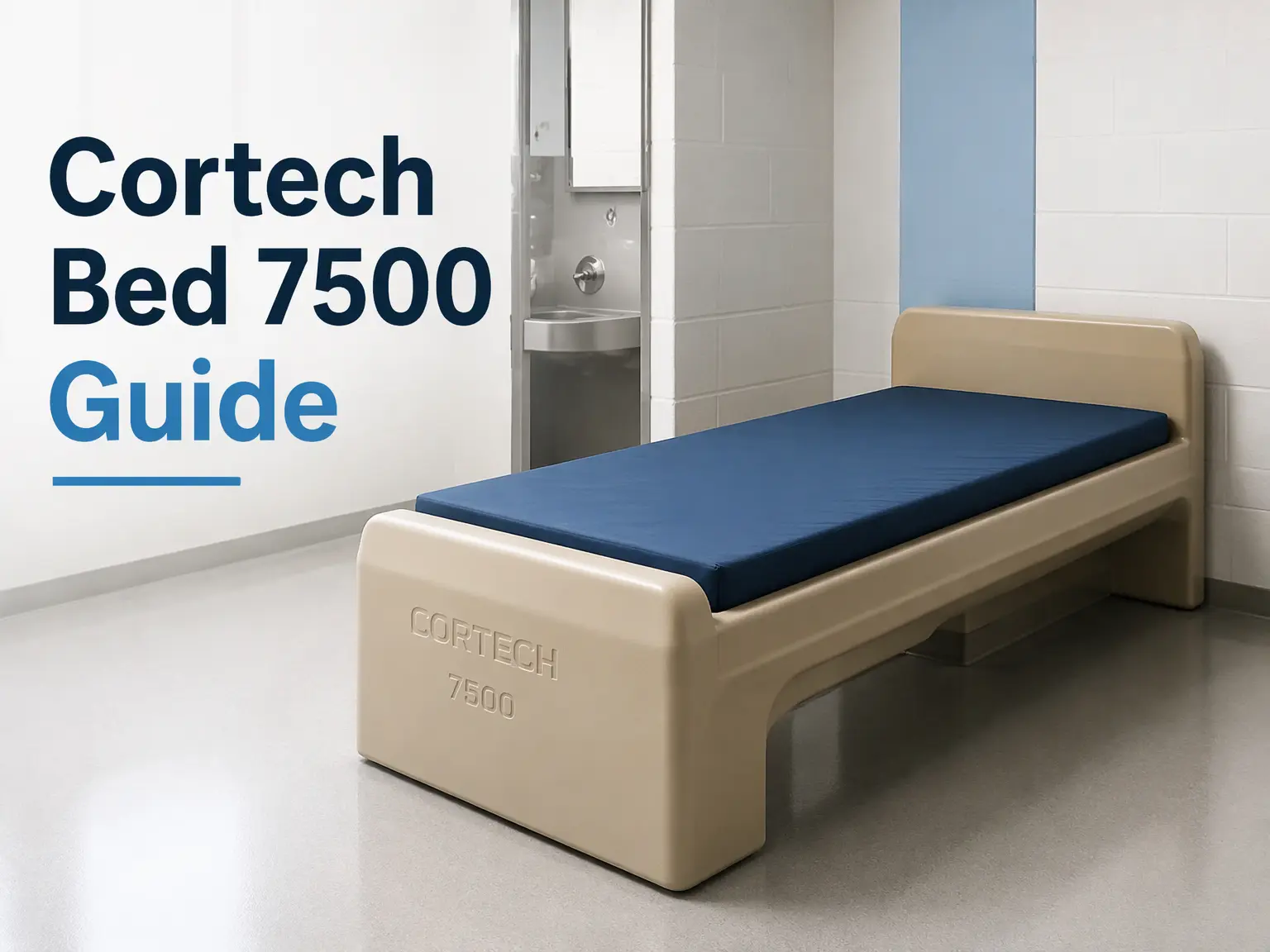
Picture a facility manager staring at a purchase order that just says “institutional bed, 79 in L.” That’s usually the moment the Cortech Institutional Bed 79 in L 7500 enters the conversation. It’s a one-piece polyethylene sleeping platform from Cortech USA, sold by industrial suppliers under that name but known to the manufacturer as the Endurance Bed 0.0. It measures 79 by 31 by 15 inches, takes a 30 by 77 inch mattress, and comes in a long list of colors. Below, you’ll find dimensions, safety details, real price ranges, and buying pitfalls, so your next order goes smoothly and nobody gets surprised by freight, hardware, or mattress size later.
What the Cortech 7500 Actually Is
The 7500 is Cortech USA’s Endurance Bed 0.0, a heavy-duty sleep surface built for places where ordinary furniture fails within months. Instead of a metal frame with wood slats, you get a single molded shell of polyethylene with no steel or wood parts at all. Cortech calls it a space saver, and it’s the shortest bed in the Endurance family. Suppliers list it as an institutional bed, and the model number 7500 never changes, though a short color code gets added at the end of it by almost every seller.
Cortech Institutional Bed 79 in L 7500 Naming Explained
Shopping for this bed gets confusing because each seller names it differently. Zoro uses the plain description with the length baked in, Global Industrial writes Endurance Bed 79 by 31, and GovVets lists it by color. The constant is the part number. Add two letters, like BK for black, SD for sand, or IG for indigo, and you’ve identified the exact configuration. When you request quotes, give each supplier the full code so everyone prices exactly the same product and nobody quietly substitutes something that’s close but not truly identical.
Key Specifications at a Glance
Before the details, here’s a quick reference you can save for your purchasing file. Every figure comes from supplier listings I checked this week, including Zoro and Global Industrial, and they agreed on the core numbers. Where retailers disagreed, such as shipping weight, I’ve left the figure out rather than guess. Treat the table as a starting point, then confirm anything that affects your room or budget with the seller before ordering, because listings change without notice and without warning. It’s also worth printing for whoever signs the final paperwork.
| Feature | Specification |
|---|---|
| Model | Endurance Bed 0.0, SKU 7500 |
| Overall size | 79 L x 31 W x 15 H inches |
| Mattress | 30 x 77 inches, 4.5 inches thick |
| Capacity | 1,500 lb |
| Material | High-impact polyethylene |
| Warranty | 10-year factory |
Overall Dimensions and Footprint
The bed measures 79 inches long, 31 inches wide, and 15 inches high. That’s a narrow, low footprint, so it fits rooms where a standard twin would crowd the door swing. Measure the floor area first, then add clearance for staff to walk around the frame and for cleaning. Remember that the 15-inch height describes the frame only. Once you add a mattress, the finished height changes, which matters if you’re checking sight lines, reach distances, or the way the room feels at night. That detail trips up first-time buyers.
Why the 79-Inch Length Matters
Length is the number buyers misread most often. A 79-inch frame sounds like it should take an 80-inch mattress, but it doesn’t. The molded sides and ends take up space, which is why Cortech specifies a 30 by 77 inch mattress for the 0.0. Standard twin mattresses run wider and longer, so they won’t drop in. If you tell a vendor you need a twin, you’ll likely receive the wrong size, and returning oversized items gets expensive fast once freight charges pile up. Always double-check the vendor’s spec sheet first.
The Right Mattress for the 7500
Cortech recommends a mattress that’s 30 by 77 inches and about 4.5 inches thick, and one listing says anything that size or smaller will work. Buy a mattress made for institutional use, ideally with a seamless, wipeable cover that matches your cleaning routine. Mattresses are typically listed separately, so budget for one. Ask the supplier whether they stock this size, since many general bedding sellers don’t carry such an unusual dimension, and custom orders can slow your installation schedule by weeks. Don’t guess, because mattress fit affects comfort and cleaning.
One-Piece Rotational Molding
Rotational molding forms the bed as a single seamless shell. Plastic powder is heated inside a rotating mold until it coats every surface evenly, then it cools into one piece. That process explains why there are no welds, screws, or bolted joints to loosen over time. For a facility that replaces conventional frames every couple of years, fewer failure points means fewer repair tickets. It also gives the bed its smooth, rounded look, which supports both durability and the safety goals behind most institutional purchases. That’s a real operational advantage.
High-Impact Polyethylene Material
Cortech builds the 7500 from high-impact polyethylene it describes as no-break material. Polyethylene is tough, doesn’t rust, and shrugs off moisture, which is why you see it in playground equipment and marine gear. It also resists the denting and splintering that damage wood and thin metal. The tradeoff is that it’s still plastic, so it won’t look like residential furniture. Listings put the shipping weight around 75 to 80 pounds, light enough for two people to carry but stable once the bed is anchored. It’s built for function, not looks.
Molded-In Sides and Ends
The bed’s sides and ends are molded directly into the shell, which Cortech says increases structural span strength. In plain terms, the frame supports itself without a lot of hidden hardware. There’s also no storage compartment, which separates the 0.0 from higher-numbered Endurance models. For some programs that’s a feature, because empty cavities are places where items can hide and staff must search. Fewer pockets and shelves mean quicker room checks and a simpler surface to clean after each occupant leaves. That’s why many programs prefer the simpler 0.0 layout.
Weight Capacity Explained
Zoro and other listings give the 7500 a 1,500-pound capacity. That figure sounds generous, and for most users it is. Still, a rating on a spec sheet assumes proper installation, so don’t treat it as permission to skip anchoring. Capacity also depends on how weight is distributed across the shell. If your facility serves larger occupants or expects heavy repeated impact, ask Cortech or the dealer for documentation instead of relying on a retailer’s summary line, and keep that paperwork on file for audits. Better to be safe than surprised.
Ligature-Resistant Design in Context
Retailers describe the 7500 as ligature resistant, and the rounded, molded surfaces support that claim. Be careful with the wording, though. Resistant isn’t the same as proof against every risk, and a bed is only one item in a room. Your facility’s risk assessment, local regulations, and clinical team decide what’s acceptable. Think of this bed as one component in a larger safety plan that also covers door hardware, lighting, bedding, and supervision, not as a standalone answer to ligature concerns. Treat safety claims as one part of the picture.
Floor Mounting Through Pilot Holes
You can bolt the bed to the floor through concealed pilot holes, which keeps fasteners out of sight and out of easy reach. Anchoring stops the bed from shifting around the room during heavy use. Cortech lets you choose your own hardware, which is flexible but puts the responsibility on you. A concrete slab needs different anchors than a raised or vinyl-covered floor, so involve your maintenance lead early and plan the installation day around the actual subfloor. Ask the installer to verify the pilot hole locations before drilling anything.
Mounting Hardware Is Not Included
Zoro’s listing states plainly that no mounting hardware comes in the box. That surprises first-time buyers who assume anchors ship with the bed. Add the fasteners to your purchase list now, along with any tamper-resistant versions your policy requires. Order a few extras, because a dropped or stripped bolt on installation day can stall the whole project. Confirm drill bit sizes, anchor lengths, and torque specs with your installer instead of improvising on-site, since floor damage is costly and annoying to repair. Small oversights like this often delay unit openings.
Restraint Rings and Accessories
One supplier notes that restraint rings can be field installed when the bed is mounted to the floor. Whether you want them depends entirely on your policies, licensing, and applicable laws, so I won’t tell you what’s appropriate. What I’d suggest is deciding before you order, because adding hardware later can be messier than specifying it up front. Ask the dealer exactly which accessories are included in the quoted price, and get that answer in writing so there are no surprises at delivery. Then confirm whether they’re covered under warranty.
Cleaning and Sanitizing Routines
Smooth polyethylene with few seams is simple to clean, and Cortech advertises the bed as easy to sanitize and maintain. A wipe-down between occupants usually takes minutes, not an hour. Stick to cleaners approved for polyethylene, because harsh solvents can dull or stress plastic over time. Check your disinfectant’s contact time too, since the surface needs to stay wet long enough for it to work. Write the routine into your housekeeping checklist so every shift cleans the bed the same way. Consistency matters more than any single product you choose.
ISO 22196 Antibacterial Testing
Cortech says the bed was tested to ISO 22196 and showed a reduction in bacteria greater than 99 percent. That’s a laboratory result for the material surface, and it’s worth understanding what it isn’t. It doesn’t make the bed sterile, and it doesn’t replace cleaning. Some listings also mention an antimicrobial compound blended into the plastic, though I’d treat that as a manufacturer claim worth confirming. Ask for the test documentation if infection-control staff are involved in your purchasing decision. Think of it as an added layer, not a cure-all.
Fire Safety Ratings
Product pages list the 7500 as passing UL 94 HB flammability testing, and Cortech’s own materials mention CAL 133 as well. Those standards matter in facilities with strict fire codes, particularly in California, where CAL 133 is well known. Notice that suppliers vary in which rating they show, so one listing may mention only UL 94 HB. Test reports are available on request, according to a distributor. Ask for them early, since your fire marshal may want to see them before approval. Don’t assume a retailer’s summary covers every standard.
GREENGUARD Gold and Indoor Air
GREENGUARD Gold certification means a product has met strict limits on chemical emissions, which makes it relevant for indoor air quality. That matters in small rooms with limited ventilation, where new plastic furniture could otherwise leave a smell. Global Industrial’s listing includes the certification. If your facility serves sensitive populations such as children or people with respiratory conditions, it’s a useful extra credential to request in writing, though it shouldn’t be the only factor in your decision. Request the certificate number if you ever need proof for an audit later.
Sound-Dampening Design
A listing for the 7500 describes it as sound dampening, which makes sense for a thick plastic shell. Hard furniture that bangs, scrapes, or rings when touched can disturb sleep and raise tension on a unit, especially at night. A bed that stays quieter helps staff hear what’s happening elsewhere in the room. I’d still call it a modest benefit rather than a main selling point, because no manufacturer publishes a decibel figure, so you can’t compare it to other beds objectively. Both staff and occupants benefit from less noise.
Behavioral Health Applications
Behavioral health units are the most common home for this bed. Zoro lists the application as behavioral or mental health facilities and hospitals, and the design matches the needs: rounded corners, no loose parts, and surfaces that clean quickly. Picture a new unit being outfitted before its inspection. The project manager wants furniture that reads as calm and residential while still meeting safety goals. Muted colors, like sand or slate blue, help here, and the low profile keeps the room feeling open. It’s a setting where every choice gets scrutinized.
Correctional Facility Applications
Cortech also markets Endurance furniture for correctional settings, and the 7500’s anchoring option and tough shell fit that environment. Jails and detention centers run beds hard, with constant turnover and little patience for repair downtime. A molded bed that can be bolted down and wiped clean fits that routine. Procurement teams often work through state contracts, so check whether your agency already has Cortech on an approved list before contacting random resellers, since contract pricing can differ noticeably from open-market quotes. Always verify what your agency’s contract actually covers first.
Other Settings Where It Makes Sense
Beyond those two markets, the bed could suit observation rooms, college health centers, or secure holding areas where durability matters more than comfort. It isn’t a good match for a guest room, a dorm, or a home. The look is utilitarian, and the 30 by 77 inch mattress size is narrow. If you’re furnishing a regular residence, a standard frame will serve you better and cost far less. Ask yourself who will actually sleep here every night. Match this product to institutional use, and you’ll be much happier with it.
Choosing Between Color Options
You’ll find the 7500 in many colors, including black, brown, gray, sand, indigo, burgundy, slate blue, blue gray, midnight blue, stone gray, moss, claylight, overcast, and tide. Color is more than decoration in a care setting. Softer tones can make a room feel less stark, while darker shades hide scuffs. Prices sometimes vary by color too, with the Zoro listings I saw split between $1,475.99 and $1,705.99. Pick your color before ordering, because swapping later usually means a return, and return freight is rarely cheap. Confirm stock before promising dates.
How the 0.0 Compares With Larger Models
The 0.0 is the smallest Endurance model. Cortech’s larger siblings add features, such as molded-in storage compartments and end shelves on the 1.0, and a taller, wider frame on the 2.0, which takes a 36 by 80 inch mattress according to the catalog. If you need extra width or built-in shelving, step up. If you’re short on floor space or want the simplest surface possible, the 7500 wins. Compare actual room plans, not marketing pages, before deciding which size fits. Cortech’s catalog and your dealer can confirm current model details.
What a Cortech Institutional Bed 79 in L 7500 Costs
Pricing depends heavily on who’s selling it. When I checked, Zoro showed $1,475.99 or $1,705.99 depending on color, Global Industrial listed $1,525 to $1,575, and GovVets showed discounted prices between roughly $1,967 and $2,294. Those are snapshots, not guarantees. Add the mattress, hardware, accessories, and freight, and the true cost of one finished bed can climb well above the sticker price. Collect at least three itemized quotes before you commit to a supplier. Prices also move with demand, contract terms, and order size, so old quotes often expire fairly quickly.
Shipping, Freight, and Surcharges
Freight is where budgets quietly break. Zoro adds a delivery surcharge of $175 to $230 per bed depending on the listing, while other sellers advertise free shipping or lead times from nineteen days to thirty business days. A 79-inch crate isn’t a normal parcel, so confirm whether delivery includes a liftgate, inside placement, or just a curbside drop. If your loading dock can’t take a long pallet, tell the seller before the truck arrives and not after. Ask whether the quoted price includes delivery, or you’ll learn the hard way.
Warranty and Made-in-USA Details
Distributor listings advertise a 10-year factory warranty, and Cortech states that the bed is manufactured in the USA to ISO quality standards. Both points help with procurement rules that favor domestic products or long-lived assets. Read the actual warranty terms, though. Commercial warranties often exclude misuse, unauthorized modifications, or improper installation, and those exclusions matter more in intensive-use settings. Save your invoice and the model code, since warranty claims usually go faster when you can identify the exact unit and purchase date. Warranty details often hide in the fine print.
Common Buying Mistakes to Avoid
The same errors show up again and again. Buyers order a standard twin mattress that won’t fit, forget mounting hardware, overlook delivery surcharges, or assume every listing includes the same certifications. Others compare prices without noticing one quote covers a mattress and another doesn’t. A less obvious mistake is skipping a floor inspection, then discovering the slab can’t hold the anchors you bought. Each one is easy to prevent with a short checklist and one extra phone call before checkout. Catching them early costs nothing, while fixing them costs plenty.
A Practical Pre-Purchase Checklist
Before you buy, walk through a short routine. Confirm the full part number with its color code. Measure the room and the delivery path. Verify the 30 by 77 inch mattress, the anchors, and any accessories. Request fire and antibacterial test reports if your policy requires them. Compare three itemized quotes that include freight. Finally, ask about lead time and return terms in writing. Doing this takes maybe an hour, and it can save you hundreds of dollars and weeks of delay. Treat it as a template you can reuse.
Frequently Asked Questions
What is the Cortech Institutional Bed 79 in L 7500?
It’s Cortech’s Endurance Bed 0.0, a one-piece molded polyethylene bed for hard-use facilities. It measures 79 by 31 by 15 inches and has no steel or wood parts.
What mattress size fits the Cortech 7500?
Cortech specifies 30 by 77 inches, about 4.5 inches thick. A standard twin won’t fit, and mattresses are usually sold separately.
How much weight can the Cortech 7500 hold?
Listings state 1,500 pounds. That assumes proper floor anchoring, so ask your dealer for written documentation if capacity is critical.
Does the Cortech Institutional Bed 79 in L 7500 include mounting hardware?
No. The bed has concealed pilot holes, but you must buy your own anchors. Confirm the right type with your installer.
How much does the Cortech 7500 cost?
Prices ranged from about $1,475 to $2,294 across Zoro, Global Industrial, and GovVets. Freight, a mattress, and hardware cost extra.
Is the Cortech 7500 made in the USA?
Yes. Cortech says it’s made in the USA, and distributors list a 10-year factory warranty. Read the actual terms before buying.
Conclusion: Is the Cortech 7500 Right for You?
The Cortech Institutional Bed 79 in L 7500 is a purpose-built, one-piece polyethylene bed that earns its place in behavioral health, correctional, and other hard-use settings. Its 79 by 31 by 15 inch footprint, 30 by 77 inch mattress, floor-mounting option, and ten-year warranty make it practical, provided you plan for hardware, freight, and a compatible mattress. Verify specs with your supplier, compare itemized quotes, and let your facility’s safety team make the final call. Get those details right, and this bed will serve your facility reliably for many years.