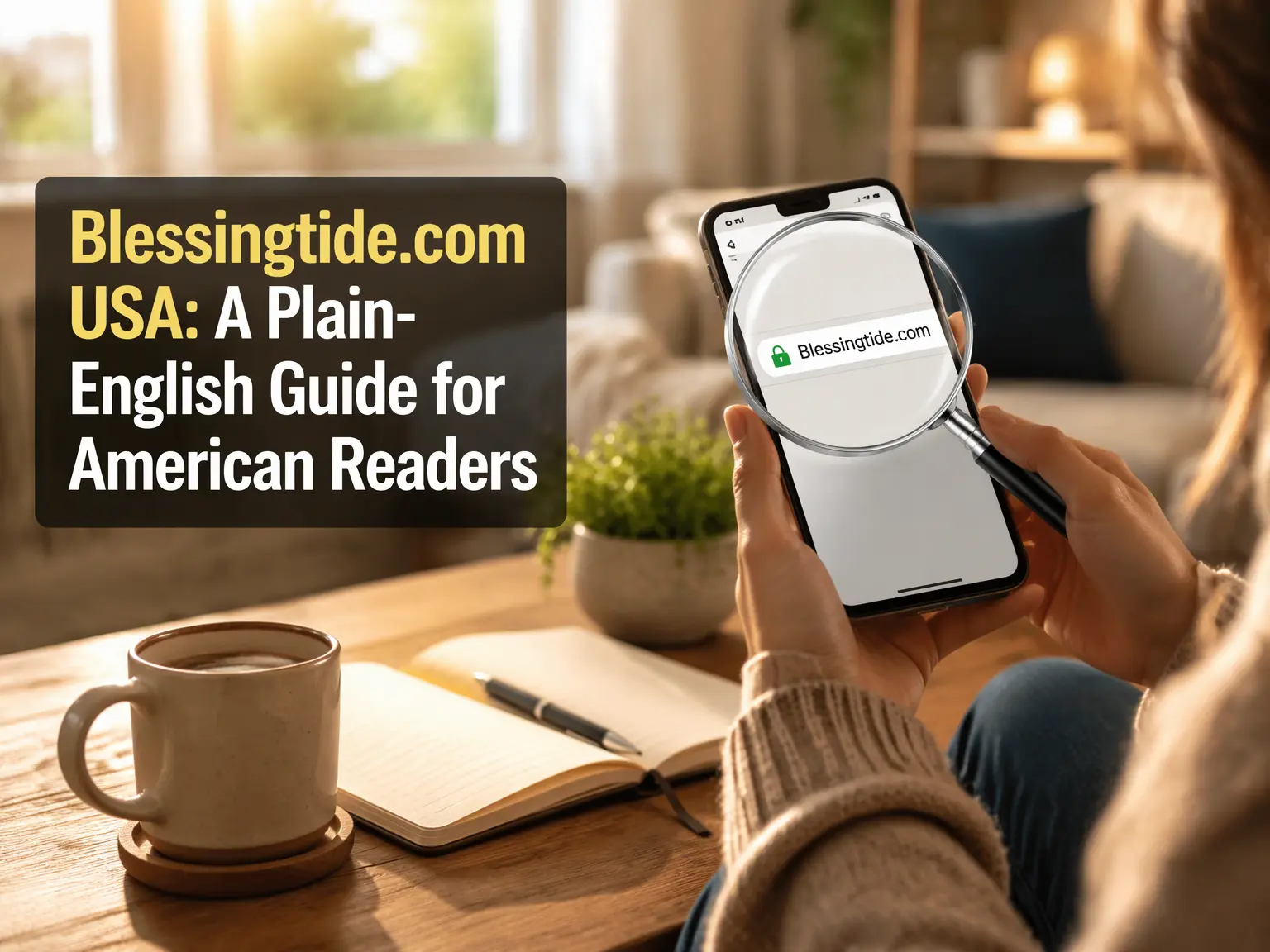
Ever typed blessingtide.com usa into Google and wondered what you were actually supposed to find? You’re not alone. The phrase keeps showing up in searches, yet most explanations skip the practical questions: what the site is, whether it’s American, and how you can check it yourself. I looked into it so you don’t have to guess. No jargon, no fluff, just honest answers you can trust. Below, I’ll walk you through what Blessingtide.com USA likely refers to, what kind of content readers associate with it, which lookalike names cause trouble, and the simple checks that keep you safe online. Everything here is written for readers in the United States, with steps you can use today.
What Blessingtide.com USA Actually Means
Blessingtide.com USA isn’t an official product name or a special American edition. It’s a search phrase, a way of asking Google about the BlessingTide website from a United States point of view. People add country names to domains all the time, usually to see whether a site serves their region. Published descriptions of the site point to an inspirational publication built around blessings, prayers, gratitude and encouragement. I couldn’t find anything official confirming a dedicated U.S. version. So treat the phrase as a doorway to the main domain, and double-check the exact address before you trust anything on the page. That small habit saves real trouble later on.
Why Americans Search for This Phrase
Why would anyone add USA to a domain name? Usually it’s curiosity mixed with caution. Some readers want to know whether the site has an American audience. Others saw the name in a social post, a text from a relative or a recommended link, and they want reassurance before clicking. A few are comparing it with other faith websites. That mix of motives explains why the phrase feels vague. It combines a navigational goal, finding the site, with an informational one, learning who runs it. Keep that in mind while reading, because a good answer should help with both goals instead of pretending everyone wants the same thing.
What I Found When Researching the Site
Here’s what I found when I searched the phrase myself. Very little independent coverage exists. The clearest explainer came from a single magazine-style blog post, and it was careful not to overclaim. Beyond that, the results were noisy: supplement promotions with similar-sounding names, tide chart sites, and unrelated stores. That tells me two things. First, there’s no deep third-party reporting on the site yet. Second, lookalike names are a real problem. I haven’t independently verified every claim made about the website, so I’m sticking to what can be checked and flagging what can’t. Treat any confident statement about ownership or location with healthy skepticism. Always ask for proof.
What the Website Says About Itself
According to published descriptions, BlessingTide presents itself as an uplifting, informational platform. Its identity leans on faith, gratitude and kind words rather than hard news or technical analysis. That matters because it sets expectations. You’d visit for a comforting thought, not a tax strategy. The tone is meant to feel warm and personal, which many readers appreciate after a very long day of scrolling through angry headlines. Still, a friendly brand voice isn’t proof of expertise. Whenever a site describes its own mission, read that as the owner’s statement. Then compare it with what the pages actually deliver, who writes them, and whether the information holds up elsewhere.
Faith and Blessing Content Readers Expect
Blessing-themed websites usually share a familiar menu: short prayers, Bible verses, morning and evening reflections, and messages you can send to family. If that’s what you’re after, BlessingTide fits the pattern described by outside writers. Readers often use this kind of material for personal quiet time, church group notes, or a card for someone going through a hard season. Faith content is personal, so interpretation varies from person to person, and that’s perfectly fine and completely normal. Just remember that inspiration isn’t instruction. A verse can comfort you, but it can’t replace a doctor, a lawyer or a financial planner when a serious decision is on the table.
Daily Encouragement and Short Reflections
Short reflections work because they’re easy. You open a page, read a few lines, and carry on with your morning. That convenience is a big reason people return to inspirational sites. If you enjoy this style, try pairing it with a routine: one reading with your coffee, one thought saved to your phone, one message sent to a friend who needs it. Small habits stick better than big plans. Whichever site you use, pay attention to how the content makes you feel afterward. Encouragement should leave you steadier, not pressured, rushed or nudged toward spending money you hadn’t planned to spend. Choose what helps, and leave the rest.
Broader Topics Beyond Faith
Some descriptions say the site’s scope reaches past faith into lifestyle, technology, business, relationships and entertainment. If that’s true, it’s a big shift from a pure prayer site, and it changes how you should read it. A devotional post and a post about your health insurance deserve different levels of scrutiny. Wide-ranging sites can be handy for a first look at a topic, but depth often suffers. Think of them as the lobby of a building, not the boardroom. You can learn where things are, then walk down the hall to an official source for the details that actually matter to your decision. Always verify before you act.
Is There a Separate USA Edition?
Short answer: nothing I found proves one exists. The primary domain is Blessingtide.com, and the USA part looks like a search habit rather than a branch of the business. Why does this matter? Because scammers love regional labels. A page claiming to be the American edition can look convincing while belonging to a completely different owner. If you land somewhere that calls itself an official U.S. version, scroll to the footer, read the contact details, and confirm the domain spelling letter by letter. When the identity feels fuzzy, close the tab and start again from a search or a link you already trust. It’s a quick, free safeguard.
Where Is Blessingtide.com Based?
Location is the question people ask most, and honestly, public information doesn’t settle it. A website can serve readers across America without being run from an American office. Hosting, ownership and audience are three separate things. A U.S. flag in a search phrase proves none of them. If location matters to you, because you’re thinking of donating, ordering something or sharing personal details, look for a physical address, a business registration, or a named contact you can verify. If none exists, that’s useful information too. You don’t need to accuse anyone. You just need to decide how much trust the available evidence supports. Evidence beats assumptions every time.
Quick Facts at a Glance
Sometimes a quick summary beats another paragraph, so here’s a compact snapshot of what’s known and what isn’t. I built it from published descriptions and my own searching, and I’ve marked uncertain items clearly instead of guessing. Use it as a starting checklist when you compare BlessingTide with any other site you meet online. If a row says unverified, that doesn’t mean something is wrong. It simply means the evidence wasn’t strong enough for me to state it as fact. Come back to the table after you’ve finished the checks below, and see whether your own findings fill in any gaps. Treat it as a living, evolving document.
| Question | What the evidence shows |
|---|---|
| Main domain | Blessingtide.com |
| Is “USA” part of the name? | No, it’s a search variation |
| Core themes | Faith, blessings, encouragement |
| Wider topics | Reported, varies by page |
| U.S. headquarters | Unverified |
| Separate U.S. edition | No proof found |
Lookalike Domains That Cause Confusion
Lookalike domains are the biggest practical risk here. While researching, I kept running into names that sounded close but led somewhere else: supplement pages, tide forecasts, gift stores. One swapped letter or a different ending, like .net instead of .com, can mean a different owner entirely. Scammers lean on this, hoping you’ll skim. Before you trust Blessingtide.com USA or any similar name, read the full address in your browser bar, not the page title. Type the domain yourself instead of tapping a link from a text or an ad. It takes just ten seconds, and it removes the most common way people end up on the wrong site.
How to Check the Exact Domain
Here’s a simple routine you can finish in under two minutes. First, tap the address bar and read the domain left to right. Second, confirm the connection shows a padlock, though remember a padlock only means encryption, not honesty. Third, search the domain in quotation marks to see what others say. Fourth, open the footer and look for contact details, a privacy policy and terms. Fifth, hover over links before clicking. If any step feels off, stop there. You’ve lost nothing. Doing this for Blessingtide.com USA, or any site your cousin shared on Facebook, builds a habit that protects you for years. Try it today on your phone.
Reading the About and Contact Pages
The About and Contact pages tell you more than the homepage does. Look for a real name, an email that matches the domain, and a description that fits the content you actually see. Vague wording like “we love sharing blessings” is fine for a mission statement, but it’s not evidence of who is accountable. Ask yourself whether you could reach a human if something went wrong. Is there a way to report an error? A correction policy? If you find these, trust goes up a solid notch. If you don’t, you can still read for inspiration, but keep your wallet and your personal details out of the conversation.
Using WHOIS and Archive Tools
Want to dig deeper? Two free tools help. The ICANN lookup at lookup.icann.org shows domain registration details, though many owners hide personal data behind privacy services, so don’t read too much into blanks. The Wayback Machine at archive.org shows how a site looked in the past, which helps you spot sudden changes in topic or design. Compare an older snapshot with today’s pages. If a faith site suddenly sells unrelated products, that’s worth noticing. Neither tool gives a final verdict. They simply add context, and context is what turns a hunch into a reasonable, informed decision about whether to trust a website. Treat them as clues, not proof.
Spotting Safety Red Flags
Most trouble announces itself if you know where to look. Be wary of pop-ups claiming you’ve won something, forced notifications, countdown timers pushing urgency, requests for card details on a free reading site, and download prompts you didn’t ask for. Poor grammar alone doesn’t prove fraud, but combined with pressure it should slow you down. If you think you’ve met a scam, report it at reportfraud.ftc.gov, the Federal Trade Commission’s reporting site. A genuine inspirational site rarely needs your Social Security number, bank login or a rush decision. When a page makes you feel hurried, that feeling is data. Trust it and step back. Close the tab calmly.
Privacy Habits for Any Inspirational Site
Privacy habits don’t change with the subject matter. A prayer page can still run trackers, and a friendly tone doesn’t switch off data collection. Use a current browser, keep your passwords unique, and think twice before typing your email into newsletter boxes. Check what a form actually asks for. Name and email for a daily verse is reasonable; birth date and phone number usually isn’t. If you share a device with family, log out before you leave. And if you enjoy sites like this regularly, consider a separate email address for newsletters, so one signup never exposes the inbox you use for banking and work. Small steps count.
How to Judge Article Quality
Good readers ask four quick questions. Who wrote this? When was it published? Does it point to sources? Can I confirm the main claim somewhere else? An article that answers none of those isn’t automatically wrong, but it deserves lighter trust. Watch for confident numbers without a source, dramatic headlines that the text doesn’t support, and recycled paragraphs that appear on several unrelated sites. Quality shows up in small details: specific examples, dates, named references, sensible caveats. Apply the same test to Blessingtide.com USA content, to my own writing here, and to anything you read at midnight on your phone. The test works everywhere. Good sources welcome scrutiny.
Health, Money and Legal Topics Need Extra Care
Some topics carry real consequences. If any site, this one included, discusses medications, symptoms, investments, taxes or legal rights, treat the page as a starting point only. A comforting article can’t know your history, your state’s rules, or your budget. For health questions, look to sources like the CDC or your own physician. For money and legal matters, check official government pages or speak with a licensed professional. That isn’t a criticism of inspirational publishing. It’s a boundary. Faith can support you emotionally while experts handle the technical side, and mixing those roles up is where otherwise careful people make costly mistakes. When in doubt, ask a professional.
Celebrity and Trend Articles: Verify First
General-interest sites often cover celebrities, viral names and trending topics, and those posts spread quickly. They also contain the most errors, because rumors travel faster than corrections. If you read about someone’s family, income or relationship on a broad site, treat it as a rumor until an interview, official profile or reputable outlet backs it up. Net worth figures are especially slippery. Two sites can publish wildly different numbers with equal confidence. A good rule: the more personal or surprising the claim, the stronger the evidence you should demand. Share cautiously, too, because passing along a mistake makes you part of its journey. Pause before you hit share.
Is Blessingtide.com USA Reliable?
Reliability isn’t a yes-or-no label, and anyone offering one deserves a raised eyebrow. For uplifting content, the stakes are low, and a site can be perfectly pleasant to read. For anything involving money, health or legal choices, the stakes rise and so should your standards. Based on what I could verify, Blessingtide.com USA is best treated as a general inspirational and informational resource with limited independent coverage. That’s neither an endorsement nor a warning. It means you should read with an open mind, verify what matters, and judge each page by what it actually says rather than by its brand name. Read it, enjoy it, and stay curious.
Common Mistakes Readers Make
I see the same slip-ups again and again. People assume USA in a search means an American company. They click the first result without reading the domain. They treat a warm tone as proof of honesty. They share articles without checking a single claim. And they hand over personal details because a page looked friendly. None of these mistakes means you’re careless; websites are designed to feel trustworthy. The fix is small: slow down for ten seconds, read the address, and ask who benefits if you click. Blessingtide.com USA is a useful example because the name invites assumptions that the evidence doesn’t actually support. Slow down and check.
Pro Tips for Getting Real Value
A few habits make this easier. Bookmark sites you’ve already checked, so you never rely on search suggestions again. Keep a note of the exact domain spelling for anything you share with older relatives, who are frequent targets of lookalike pages. Use private browsing when you’re just exploring. Save the date you visited, since websites change. If you want the encouragement without the risk, subscribe through a method you control, like an RSS reader or a separate email address. Finally, trust your gut when something nags at you. It usually spots small inconsistencies before your conscious mind can name them. Habits like these make safer browsing feel effortless.
Real-Life Examples of Smart Checking
Picture Maria in Ohio, who gets a link from her sister saying “read this, it’s beautiful.” She reads the domain, spots an extra letter, and types the correct address herself. Disaster avoided. Or think of Daniel in Texas, who searches Blessingtide.com USA hoping to find an American office, checks the footer, finds no address, and decides to enjoy the readings without donating. Both made sensible choices without being cynical. Neither needed technical skill. They paid attention, used two or three of the checks above, and matched their trust to the evidence. That’s all this guide asks of you, and it genuinely works. You can do the same today.
What Site Owners Can Do Better
If you run a site like this, or any small publication, you can make life easier for readers. Publish a clear About page with real names. List a working contact email on your own domain. Date every article and show who wrote it. Explain whether your content is opinion, inspiration or factual reporting. State where you’re based, even if it’s simply a country. These details cost almost nothing, yet they answer the exact questions behind searches like Blessingtide.com USA. Transparency also helps search engines understand your site, and it gives visitors a reason to stay, return and recommend you to friends. Readers notice effort, and they reward it.
Conclusion: Blessingtide.com USA in a Nutshell
So what should you take from all this? Blessingtide.com USA is a search phrase, not proof of an American edition or office. The site is described as an inspirational platform with a broader range of topics, but independent coverage is thin, and lookalike domains are everywhere. Check the exact address, read the About and Contact pages, use free tools when something feels off, and keep serious decisions with qualified sources. Do those things and you can enjoy encouraging content without worry. Take just two minutes today to verify any site you rely on. You’ve got this, and a little extra care now saves a lot of trouble later.