
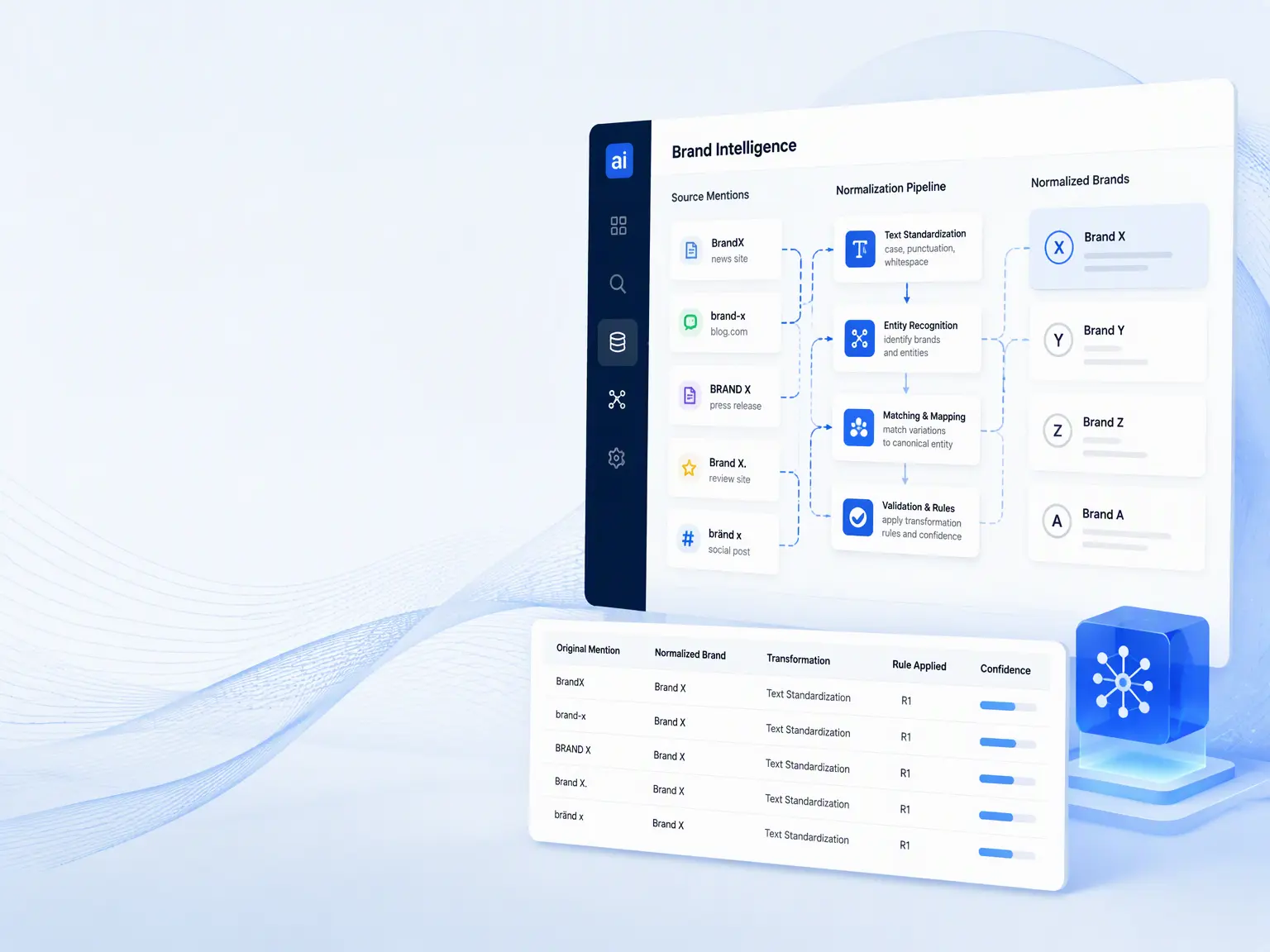
When businesses track how artificial intelligence describes their brands, inconsistent data can make the results difficult to understand. A company might appear under several name variations, its products might be confused with competitors, and different AI answers might describe the same brand in different ways. This is where normalization and data transformation become useful.
BrandRank.ai normalization transformation rules is a search term associated with standardizing brand information and analyzing how brands appear in AI-generated answers. However, there is an important distinction: BrandRank.AI publicly documents its AI visibility monitoring and brand analysis capabilities, but a proprietary technical specification under this exact name has not been verified in the public documentation reviewed for this article.
Understanding this distinction helps marketers, SEO professionals, and business owners use reliable data practices without confusing general industry concepts with confirmed product features.
What Are BrandRank.ai Normalization Transformation Rules?
BrandRank.ai normalization transformation rules can be understood as a practical approach to preparing brand information for consistent analysis.
Normalization standardizes information that appears in different forms. Transformation converts that information into a structure that software can process, compare, and report.
For example, a brand might appear in collected data as:
- BrandRank AI
- BrandRank.AI
- BRANDRANK.AI
- Brand Rank AI
A data-processing workflow can map verified variations to one approved brand identity while preserving the original wording for reference.
After standardizing the information, a transformation process can organize observations into fields such as brand mentions, recommendations, citations, and potential inaccuracies.
These examples explain established data-management concepts. They should not be interpreted as a disclosure of BrandRank.AI’s proprietary implementation.
What Is BrandRank.AI?
BrandRank.AI is a platform focused on monitoring brand representation in AI-generated answers. Its public materials describe tracking priority queries, analyzing generated responses, examining cited sources, and identifying opportunities to improve brand visibility and accuracy.
Its documented areas of focus include:
- AI Search Visibility: Understanding whether and how often a brand appears in AI-generated answers.
- Brand Vulnerability: Identifying potential risks involving inaccurate information, omissions, or competitor representation.
- Content Readiness: Assessing whether brand content is structured and supported well enough to be understood and cited.
- Recommendation Share: Measuring how often a brand is selected as a recommendation in the answers being evaluated.
These capabilities address an important challenge for modern marketing teams: knowing not only whether a brand appears in AI answers, but also how it is represented.
For more information, visit the official BrandRank.AI website or its official FAQ.
Normalization vs. Transformation: What Is the Difference?
Although normalization and transformation are related, they solve different problems.
Normalization makes equivalent information consistent. Transformation changes information into a format suitable for a particular task.
Consider a company whose name appears differently across its website, business listings, and AI-generated answers.
Normalization identifies verified variations and connects them to the appropriate company record. Transformation then organizes the collected information into a report that helps a marketing team understand what happened.
| Feature | Normalization | Transformation |
|---|---|---|
| Main purpose | Standardize inconsistent information | Convert information into a useful structure |
| Typical input | Names, URLs, dates, and categories | Raw text and standardized records |
| Typical output | Consistent values and entity identities | Structured records, labels, and metrics |
| Example | Mapping verified brand aliases to one identity | Recording whether an answer mentions or recommends a brand |
| Main risk | Incorrectly merging different entities | Misclassifying information or losing context |
The key difference: Normalization answers, “Does this information refer to the same thing?” Transformation answers, “How should we organize this information for analysis?”
Both are useful when building reliable AI visibility reports.
How Normalization Transformation Rules Work
A practical workflow can be divided into several stages. The following steps describe general data-processing practices rather than a confirmed internal BrandRank.AI algorithm.
1. Collect the Original Data
Start by collecting the information you want to analyze.
Depending on the project, this might include:
- AI-generated answers to relevant customer questions
- Brand and product names
- Website URLs and cited sources
- Competitor mentions
- Publication dates and market information
Keep the original data intact. Without it, you may struggle to investigate incorrect matches or explain a change in your results.
2. Standardize Brand Names
Create an approved record for each brand.
For example, a fictional business called Northstar Analytics might appear as “Northstar Analytics,” “NORTHSTAR ANALYTICS,” or “Northstar Analytics Inc.”
A normalization process can map verified variations to a canonical brand name.
However, the legal company name should remain available when it is needed for contracts, compliance, or formal reporting.
Do not automatically treat every similar name as the same organization.
3. Normalize Website URLs
The same webpage can sometimes be accessed through URLs that differ in capitalization, tracking parameters, or other technical details.
For example:
https://example.com/products?utm_source=newsletter
and
https://example.com/products
may refer to the same underlying page.
A URL normalization process can remove irrelevant tracking parameters when appropriate and standardize the representation of equivalent URLs.
However, different pages should not be merged simply because they share a domain.
For website owners, Google’s canonicalization documentation provides additional guidance on handling duplicate or similar URLs.
4. Separate Brands, Products, and Parent Companies
Entity relationships require special attention.
Imagine that Northstar Analytics owns a product called Northstar Pulse.
A report might mention the product without naming the parent company. A reliable data model should preserve the product-to-company relationship without automatically treating every product mention as a direct recommendation of the parent brand.
This distinction becomes especially important when comparing multiple products, subsidiaries, or business divisions.
5. Convert Raw Answers Into Structured Data
AI-generated answers are written in natural language. To analyze them systematically, a workflow can extract relevant information into predefined fields.
For example, a fictional AI answer might say:
“Northstar Analytics is a suitable option for small businesses seeking reporting software. Competitor One is another alternative.”
The answer could be represented as follows:
| Field | Example result |
|---|---|
| Brand mentioned | Yes |
| Recommendation detected | Yes |
| Competitor mentioned | Yes |
| Product category | Reporting software |
| Target audience | Small businesses |
| Source cited | Check the original answer |
| Accuracy status | Requires verification |
These are illustrative fields, not confirmed BrandRank.AI database fields or output.
The important principle is to make every classification traceable to the original answer.
6. Validate the Results
Automated processing can make mistakes.
A system might confuse two companies with similar names, interpret a neutral statement as a recommendation, or overlook a negative claim.
Review uncertain matches manually. Check factual claims against reliable sources, and record corrections so the same error does not continue appearing in future reports.
7. Compare Results Over Time
Once the data is consistent, compare results across reporting periods.
For meaningful comparisons, keep the test questions, collection methods, AI platforms, and scoring definitions as consistent as possible.
If you change the methodology, document the change. Otherwise, a difference in the report might reflect the new measurement process rather than an actual change in brand representation.
Practical Rules for Accurate Brand Data Normalization
The following table summarizes useful practices for organizations building an AI visibility monitoring process.
| Rule | What to do | Why it matters |
|---|---|---|
| Canonical naming | Maintain one approved name for each entity | Reduces inconsistent brand records |
| Alias mapping | Connect verified variations to the correct entity | Improves identification |
| URL standardization | Identify equivalent URLs without merging distinct pages | Reduces duplicate source records |
| Entity separation | Distinguish brands, products, and subsidiaries | Prevents incorrect attribution |
| Duplicate detection | Remove accidental duplicate observations | Improves reporting accuracy |
| Context preservation | Retain language, country, and relevant dates | Makes comparisons more meaningful |
| Recommendation classification | Separate recommendations from ordinary mentions | Produces more useful visibility metrics |
| Source verification | Check factual claims against reliable evidence | Helps identify misinformation |
| Exception handling | Send ambiguous matches for human review | Reduces false matches |
| Audit history | Retain original answers and record corrections | Makes results easier to verify |
These practices are useful whether a business uses a dedicated monitoring platform or maintains its own reporting system.
Why Normalization Matters for AI Search Visibility
Consistent data supports better analysis. It does not automatically make an AI system recommend a particular business.
More Reliable Brand Mention Counts
If the same brand appears under several verified name variations, an analysis that treats every variation as a separate company may underestimate its overall presence.
Entity resolution can help consolidate those observations without losing the original wording.
Better Competitor Comparisons
Competitor analysis becomes less reliable when products, parent companies, and similarly named businesses are incorrectly grouped together.
A consistent data model helps teams compare the right entities.
Clearer Citation Analysis
A brand mention is not the same as a citation.
An AI-generated answer might name a company without linking to a source. Another answer might cite the company’s website without explicitly recommending its products.
Tracking these outcomes separately helps businesses understand the difference between being mentioned, being referenced, and being recommended.
Faster Identification of Incorrect Information
A structured workflow can make it easier to flag outdated descriptions, incorrect product details, and claims that need investigation.
The original answer and its sources should remain available so a reviewer can determine whether the issue is genuinely inaccurate.
More Useful Marketing Decisions
Consistent reporting helps teams identify questions where their brand is absent, where competitors appear more frequently, and where published content may need clarification.
These findings can inform content improvements, but they do not establish that normalization alone improves AI rankings or guarantees citations.
Common Mistakes to Avoid
Even a well-designed normalization process can produce misleading results when its rules are too aggressive or poorly documented.
Treating Similar Names as Identical
Two organizations can have similar names without being related.
Do not merge records based on spelling alone. Use supporting information such as official domains, product relationships, and geographic context.
Confusing Mentions With Recommendations
An AI answer might mention a company while warning readers about a limitation.
Counting that response as a positive recommendation would distort the report.
Use separate fields for mentions, recommendations, sentiment, and factual accuracy.
Removing Too Much Information
Standardization should not erase useful distinctions.
For example, a product’s older version may be different from its current version. A regional subsidiary may have different offerings from its parent company.
Preserve these relationships rather than forcing every record into a single category.
Assuming Every Change Improves Visibility
Cleaning data improves the quality of analysis when it resolves genuine inconsistencies. It does not guarantee that an AI platform will change its answer.
Measure outcomes instead of assuming that a technical change has produced a marketing benefit.
Ignoring the Original Evidence
A dashboard may summarize thousands of observations, but teams still need access to the original answers and cited sources.
Without that evidence, it becomes harder to verify classifications, investigate mistakes, and explain changes to stakeholders.
How to Implement a Normalization Workflow
Businesses do not necessarily need a complicated system to get started.
A spreadsheet can be sufficient for an initial audit.
Step 1: Create a Brand Reference Sheet
Record the following information:
- Official brand name
- Verified alternative names
- Official website
- Parent company, if applicable
- Products and subsidiaries
- Relevant countries and languages
Assign each entity a unique internal identifier if you manage multiple brands or products.
Step 2: Build a Consistent Test Set
Choose questions that reflect how customers research your category.
Examples include:
- What are the best reporting tools for small businesses?
- Which software offers automated reporting?
- How does Northstar Analytics compare with competing tools?
- What are the main limitations of Northstar Analytics?
Use a consistent set of questions when comparing results over time.
Step 3: Record Each AI Answer
For every observation, save the prompt, platform, date, full response, and cited URLs where available.
Avoid combining results from different platforms or dates into a single observation without preserving those distinctions.
Step 4: Apply Documented Rules
Write down how your team handles name variations, URLs, duplicates, recommendations, and uncertain matches.
Use the same definitions across reporting periods.
Step 5: Review Exceptions
Manually inspect ambiguous brand matches and classifications that could materially affect the results.
Correct errors without deleting the original evidence.
Step 6: Track Meaningful Changes
Compare the results after updating your content or public brand information.
Look for changes in brand mentions, recommendations, citations, and factual accuracy. Consider other possible explanations before attributing an improvement to a specific change.
Frequently Asked Questions
What are BrandRank.ai normalization transformation rules?
The phrase describes an approach to standardizing brand information and converting raw data into structured records for analysis. It is useful to understand the underlying concepts, but a proprietary technical specification under this exact name has not been verified in the public BrandRank.AI documentation reviewed for this article.
Has BrandRank.AI officially published these exact rules?
The official website and FAQ describe AI visibility monitoring, brand analysis, and the Brand Health and Trust framework. The public materials reviewed do not establish a separately documented product feature called “normalization transformation rules.” Check the company’s official FAQ for its published capabilities.
What is the difference between normalization and transformation?
Normalization standardizes equivalent information, such as verified variations of a company name. Transformation converts data into a structure suitable for reporting, such as fields indicating brand mentions or recommendations.
How do normalization rules help with AI visibility analysis?
They can reduce duplicate records, improve brand identification, and make comparisons more consistent. Their value depends on accurate rules and appropriate validation.
Can normalization improve AI search rankings?
Normalization can improve the reliability of brand data and reporting. It does not, by itself, guarantee higher search rankings, AI citations, or recommendations.
What is the difference between a brand mention and a brand recommendation?
A mention means that a brand appears in an answer. A recommendation means that the answer actively suggests the brand as an option. These outcomes should be tracked separately.
Do small businesses need specialized software?
Not necessarily. A spreadsheet containing approved brand names, aliases, test questions, original AI answers, and classification results can provide a useful starting point.
How often should normalization rules be reviewed?
Review them whenever a brand changes its name, launches new products, acquires another company, or expands into new markets. Periodic reviews are also useful for identifying errors that automated processes may miss.
Conclusion
BrandRank.ai normalization transformation rules are best approached as a practical data-management topic rather than an assumed proprietary algorithm.
Normalization helps establish consistent brand identities. Transformation organizes collected information into a format that supports meaningful analysis. Together, these practices can make AI visibility reporting more reliable and easier to audit.
The most important steps are straightforward: maintain accurate brand records, preserve original AI answers, distinguish mentions from recommendations, validate uncertain matches, and measure changes using consistent methods.
Most importantly, separate verified company capabilities from general data-processing recommendations. That approach produces more trustworthy analysis and helps businesses make better-informed decisions about their AI search visibility.