
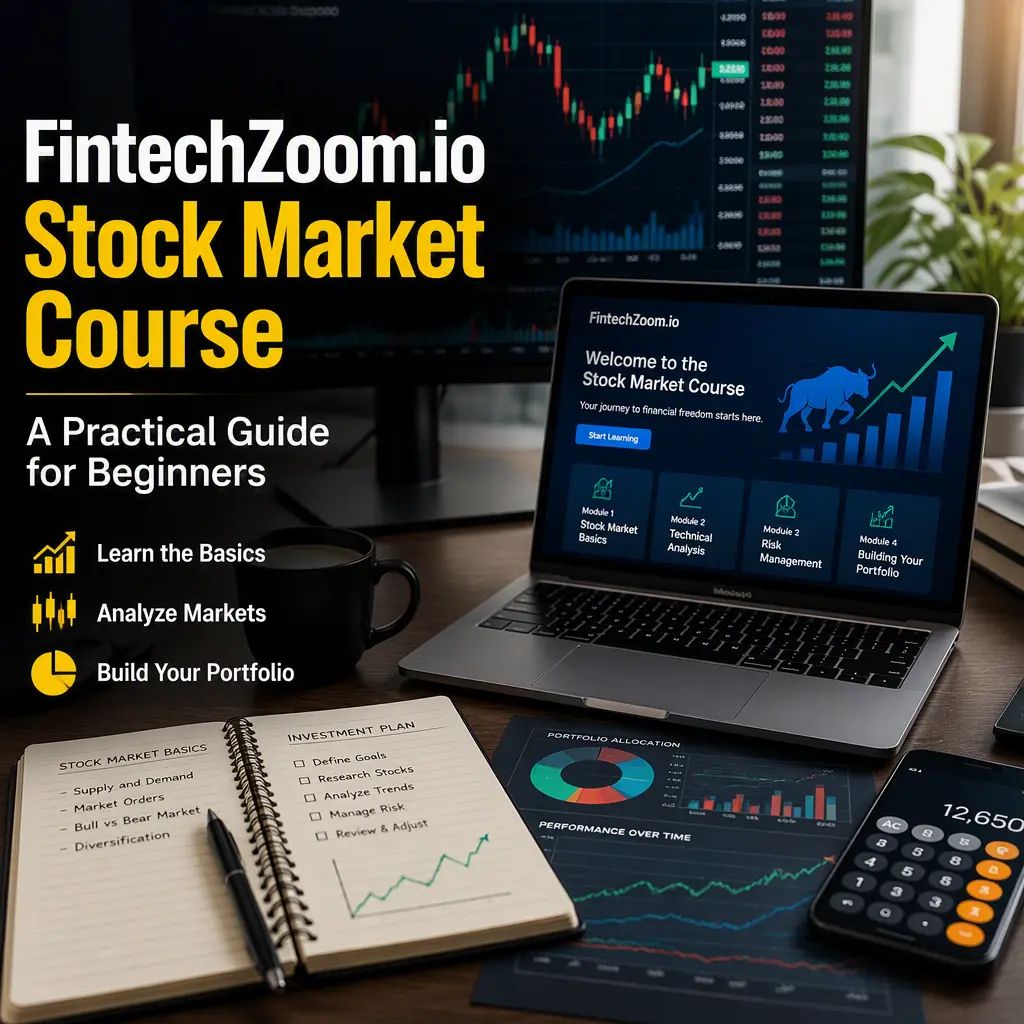
The fintechzoom.io stock market course has attracted attention from people who want a structured way to learn trading and investing instead of jumping between random videos and social-media tips.
The platform currently presents separate education options for stock market trading and stock market investing, with topics such as technical analysis, market fundamentals, risk management, portfolio building, and trading psychology.
But there is another question worth answering before looking at the lessons: what can actually be verified about the course and its operator? That distinction matters when money or personal information is involved. This guide explains what the platform says it offers, how the trading and investing tracks differ, and what beginners should check before enrolling.
What Is the FintechZoom.io Stock Market Course?
FintechZoom.io presents its stock education through separate trading and investing programs rather than one single course. The trading program is described as a self-paced learning option covering market fundamentals, candlestick patterns, trends, trading styles, indicators, risk management, psychology, and other market topics.
The investing program takes a broader, longer-term approach involving diversification, asset allocation, equities, bonds, ETFs, portfolio construction, and investment strategies. The site also lists financial literacy education.
Public course information says the trading material contains roughly 4–6 hours of on-demand lessons, while the investment course is listed at around 7–8 hours. These are provider-published details, so prospective students should confirm the current curriculum and access terms directly before paying.
What Does the Trading Course Teach?
The trading-focused material covers several concepts that beginners commonly encounter when opening a brokerage account. According to the published course description, subjects include candlestick patterns, price trends, technical indicators, day trading, swing trading, position trading, stop-loss strategies, trading psychology, market news, options, forex, margin, and algorithmic trading.
That broad list can give a new learner useful vocabulary and a basic framework for understanding market activity. However, breadth should not be confused with depth.
A course mentioning ten subjects does not automatically mean each subject receives advanced instruction, real-world testing, or professional-level analysis. Anyone considering enrollment should request a detailed module list and sample lesson before assuming that a particular strategy will be taught thoroughly.
How Is the Investing Course Different?
Trading and investing may involve the same financial markets, but the decision-making process can be very different. The investing course described by FintechZoom.io focuses more heavily on long-term portfolio decisions, including risk and return, compounding, stocks, bonds, mutual funds, ETFs, asset allocation, diversification, value investing, dividend strategies, and passive index approaches.
It also lists topics such as behavioral finance, international markets, options, futures, and alternative assets. Someone saving for long-term financial goals may therefore be more interested in the investing curriculum than lessons centered on short-term price movements.
The key is to identify your objective first. Learning about charts for active trading and learning how to construct a diversified portfolio are related skills, but they should not be treated as interchangeable.
What Should You Verify Before Paying?
The biggest gap in many online discussions is verification. Public course pages provide useful descriptions, but important purchasing details may not always be clear enough from the information available.
Before paying, ask for the exact current price, complete syllabus, instructor names, instructor credentials, access period, refund conditions, support arrangements, and legal entity receiving payment.
Also check whether “lifetime access” has a clearly defined meaning and whether future course updates are included. A professional-looking website is not enough evidence of educational quality. One competing analysis found that public pages did not clearly establish several of these details, including named instructors and transparent pricing.
Is FintechZoom.io Connected to FintechZoom.com?
This is the most important issue to understand before enrollment. FintechZoom.io currently publishes financial content and course pages under the FintechZoom name, but FintechZoom.com has stated that fintechzoom.io is not affiliated with it and identifies the .io domain in a warning about sites it says are impersonating its brand.
That creates a clear distinction between a course appearing on fintechzoom.io and a course being officially authorized by FintechZoom.com. The existence of course pages does not independently resolve that dispute.
Anyone considering the program should verify the operator, ownership, payment recipient, and authorization directly rather than assuming that similar branding means the two websites belong to the same organization.
Can the Course Guarantee Trading Profits?
No educational course can remove the risks of the stock market or guarantee profitable results. Understanding candlestick patterns, technical indicators, portfolio allocation, or trading psychology can improve financial knowledge, but market prices remain uncertain.
A trader can correctly understand a strategy and still experience losses because of volatility, poor execution, changing market conditions, or an incorrect assumption. Even diversification does not prevent a portfolio from declining during a broad market downturn.
This is why beginners should separate education from performance claims. A certificate can show that a learner completed coursework, but it does not prove profitable trading, investment expertise, professional licensing, or regulatory authorization to provide personalized financial advice.
How Should Beginners Evaluate the Course?
A simple evaluation process can prevent many expensive mistakes. Start by deciding whether you want to learn active trading, long-term investing, or basic financial literacy.
Then compare the published syllabus with your goal and ask for specific information that is missing. Check the instructor’s background independently instead of relying only on phrases such as “finance experts.” Review the refund policy before entering payment information, and confirm the legal business receiving your money.
It is also useful to compare the course with established educational resources from regulators, universities, and reputable financial organizations. This approach does not automatically prove whether a course is valuable, but it gives you evidence for making a more informed decision.
Who Might Find This Course Useful?
The course structure may appeal to beginners who prefer organized, self-paced lessons over collecting information from dozens of unrelated sources. A learner interested in trading can explore technical analysis, market terminology, risk management, and trading psychology, while someone focused on long-term investing can study diversification, asset allocation, and portfolio concepts.
However, people seeking accredited academic qualifications, personalized investment advice, guaranteed returns, or highly advanced professional trading systems should examine the offering much more carefully.
The public descriptions establish the subjects the provider says it covers, but they do not independently establish outcomes for students. Treat the curriculum as educational material to investigate, not as evidence that completing the program will produce a particular financial result.
Frequently Asked Questions
1. What is the FintechZoom.io stock market course?
The FintechZoom.io stock market course is an online learning program covering stock trading and investing topics such as technical analysis, risk management, market fundamentals, portfolio building, and trading psychology.
2. Is the FintechZoom.io stock market course suitable for beginners?
Yes. The course is designed to provide structured, self-paced education for people learning about stock trading and investing. Beginners should review the syllabus before enrolling.
3. What topics are covered in the FintechZoom.io stock market course?
The course covers topics such as stock market fundamentals, candlestick patterns, technical indicators, trading strategies, risk management, diversification, asset allocation, and trading psychology.
4. Does the FintechZoom.io course guarantee stock market profits?
No. The course cannot guarantee profits. Stock trading and investing involve financial risks, and completing an educational course does not ensure successful investment results.
5. Is FintechZoom.io a good option for learning stock trading?
It may be useful for learners looking for structured online material, but users should verify the syllabus, instructors, pricing, refund policy, and course provider before enrolling.
6. What should I check before buying the FintechZoom.io stock market course?
Check the current course price, syllabus, instructor information, access period, refund terms, payment details, and the identity of the organization operating the course before making a purchase.
Final Takeaway: FintechZoom.io Stock Market Course
The fintechzoom.io stock market course presents a broad selection of trading and investing topics, including technical analysis, risk management, portfolio concepts, market psychology, and different investment approaches.
The self-paced format may suit learners who want structured education, but the published information should be checked carefully before purchase. Most importantly, don’t assume that fintechzoom.io is the same organization as FintechZoom.com because the latter has publicly disputed that affiliation. Verify the seller, instructors, syllabus, pricing, refund terms, and payment details first.
A stock-market course can teach useful concepts, but it cannot guarantee profits. The smartest next step is to verify the details independently and choose education that matches your actual financial goals and experience level.