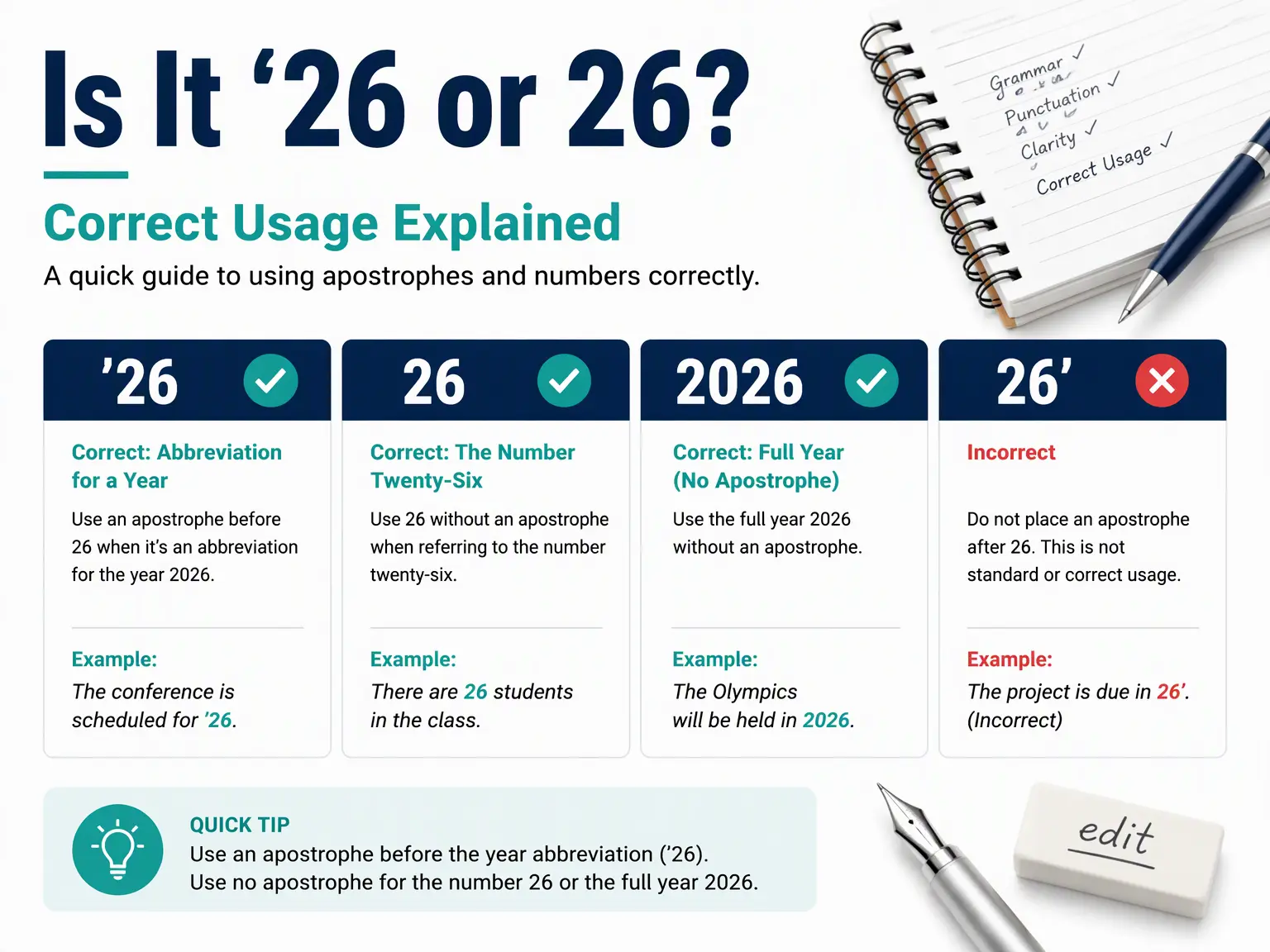
Have you ever written “Class of 26” and wondered whether an apostrophe was missing? This tiny punctuation mark can change how readers understand your message. The difference between ’26 or 26 depends on whether you mean an abbreviated year or the number twenty-six.
When you shorten 2026 to ’26, the apostrophe indicates that the first two digits have been omitted. By contrast, 26 without an apostrophe represents an ordinary number, such as someone’s age, a quantity, or a score. Understanding this simple grammar rule helps you write clearer school announcements, social media captions, business messages, and professional documents.
What Is the Difference Between ’26 and 26?
The main difference is what the number represents. Both forms can appear in everyday writing, but they aren’t interchangeable.
| Format | Meaning | Example |
|---|---|---|
| ’26 | An abbreviated year, usually 2026 in current contexts | Class of ’26 |
| 26 | The number twenty-six | She turned 26. |
| 2026 | The complete calendar year | The event takes place in 2026. |
| 26′ | A measurement of 26 feet | The room is 26′ wide. |
The apostrophe in ’26 replaces the omitted digits “20.” This follows the same general principle used in contractions such as don’t, where an apostrophe marks missing letters.
When Should You Write 26 Without an Apostrophe?
Use 26 when referring to a number rather than an abbreviated year.
Examples include:
-
Age: My brother is 26 years old.
-
Quantity: We ordered 26 books.
-
Score: The team scored 26 points.
-
Page number: Read page 26.
-
Measurement: The table is 26 inches long.
Adding an apostrophe to these examples would change the intended meaning or create incorrect punctuation.
When Should You Use ’26?
Use ’26 when you intentionally shorten a year ending in 26. In a contemporary context, it commonly represents 2026, although it can refer to another year, such as 1926, when the context makes that meaning clear.
Common Examples of Abbreviated Years
-
Graduation: Welcome, Class of ’26!
-
Marketing: Introducing our Spring ’26 collection.
-
Social media: Making plans for ’26.
-
Events: See you at the reunion in ’26.
The apostrophe belongs before the digits, not after them. Writing ’26 signals that the number is a shortened year rather than an ordinary count.
Is ’26 Appropriate for Formal Writing?
It depends on your document and audience. Abbreviated years work well in informal writing, event branding, graduation announcements, and short promotional headlines. They save space and are easy to recognize when the context is clear.
For academic papers, legal documents, business reports, and formal correspondence, writing the complete year as 2026 is generally clearer.
Compare these examples:
-
Informal: Our new office opens in ’26.
-
Formal: Our new office opens in 2026.
-
Graduation announcement: Congratulations to the Class of ’26!
Choose clarity over brevity. If readers might confuse 2026 with another year, use all four digits.
Common Mistakes to Avoid
Small punctuation errors can make otherwise polished writing look careless. Watch for these common problems:
-
Leaving out the apostrophe: “Class of 26” is less precise when you mean the graduating class of 2026.
-
Placing the apostrophe after the number: Use ’26 for an abbreviated year, not 26’.
-
Adding punctuation to an age: Write “She is 26,” not “She is ’26.”
-
Confusing years with measurements: In technical contexts, 26′ can mean 26 feet; inches are typically represented by a double-prime symbol (″).
-
Using abbreviations without context: Write 2026 when the intended century isn’t obvious.
One useful editing habit is to read the entire sentence before correcting punctuation. The surrounding words usually reveal whether the number represents a year, age, quantity, or measurement.
Quick Tips for Choosing the Correct Format
Before publishing your writing, ask yourself these three questions:
-
Am I referring to a year? Use ’26 for an abbreviated year when the meaning is clear.
-
Am I describing an age or quantity? Use 26 without an apostrophe.
-
Is this formal or technical writing? Prefer 2026 for a year, and use the appropriate measurement symbols for dimensions.
Consistency also matters. If you’re creating a graduation campaign or a marketing design, use the same year format across headings, graphics, and captions. This makes your content easier to read and gives it a more professional appearance.
Frequently Asked Questions
Is it ’26 or 26 when referring to 2026?
Use ’26 when abbreviating 2026 in an appropriate context. Use 2026 when you want the complete year, particularly in formal writing.
Is “Class of ’26” grammatically correct?
Yes. “Class of ’26” is a common abbreviated way to identify a graduating class from 2026. The apostrophe marks the omitted digits.
Does the apostrophe go before or after 26?
It goes before the digits: ’26. This indicates that the beginning of the year has been omitted.
Can ’26 mean 1926 instead of 2026?
Yes. The abbreviation can refer to different years ending in 26. Readers rely on the surrounding context to identify the intended year.
Should I write 26 or ’26 for someone’s age?
Write 26 without an apostrophe. For example, “He is 26 years old” uses the ordinary number, not an abbreviated year.
Is 26′ the same as ’26?
No. In measurement notation, 26′ commonly means 26 feet, while ’26 represents an abbreviated year. The position and function of the mark matter.
Conclusion
Choosing between these formats becomes simple when you identify what the number represents. Remember these key points:
-
’26 means an abbreviated year, often 2026.
-
26 means the number twenty-six.
-
2026 is the clearest option for formal writing.
-
26′ can indicate a measurement of 26 feet.
Check your context, place the apostrophe correctly, and keep your formatting consistent. Once you understand the distinction between ’26 or 26, you’ll be able to write dates, announcements, and everyday messages with greater confidence.